Welcome to a new monthly series by and for game writers. Each month we’ll look at a new narrative-centric game, examining what makes it unique, what other developers can learn from it, and why you (yes you) should go play it.
Enjoy! ~Jackson
ScribeOS
This June, I found myself at the Narrascope conference in Albany, wondering morbidly if passers-by thought I was on drugs. I was sitting across from a fellow attendee I’d met fifteen minutes ago, and we were, in full public view, animatedly chanting nonsense at each other while maintaining unbroken eye contact. In actuality, we were playing ScribeOS, one of the games being exhibited, and its unique blend of physical and digital spaces is like nothing I’ve seen before or since.
Check out ScribeOS here
To begin, each player is seated in front of a computer running a program that wouldn’t look out of place in the 1995 movie Hackers:
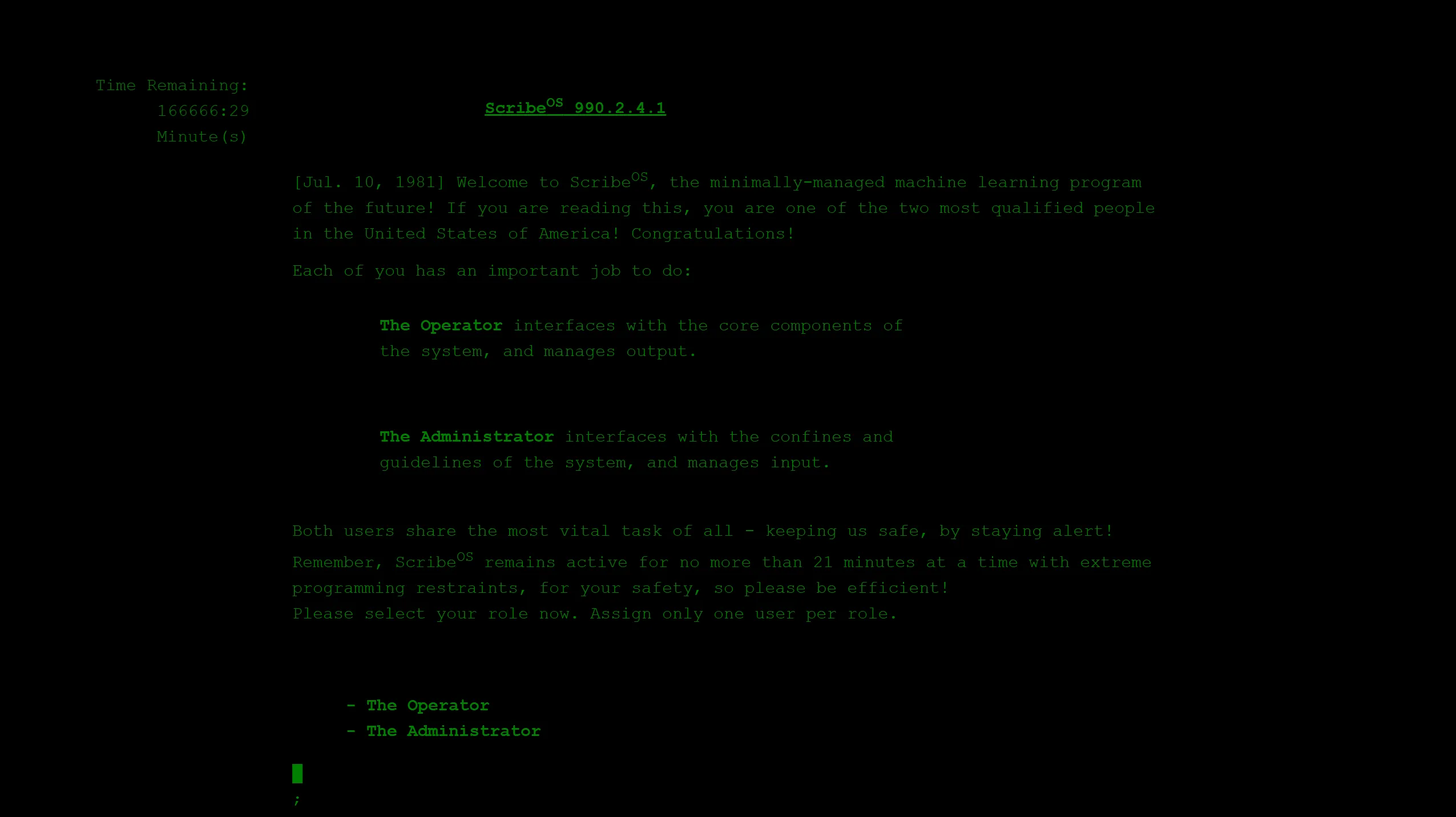
Players select their roles and are told two things: not to communicate with the other player and to not trust them. Then the 21-minute timer begins. It begins deceivingly mundane—answering seemingly random questions, many of which you are encouraged to record your answers to on physical paper. At about the 11-14 minute mark, things get interesting. The system stops simply presenting questions and begins claiming, quite emphatically, that the other player can’t be trusted. Tension builds as the instructions become increasingly out there, reach across the table and steal the other player’s notes, start chanting nonsense like a maniac, etc. scribeOS goes to great lengths to convince you that the person sitting across the table is actively trying to mess with you. In one particularly memorable instance, it asks both players whether they wish to undermine the other; if both pick no, nothing will happen, but if one picks yes, the hapless dupe will be locked out of the system. It’s a beautiful paranoia simulator that starts with questions about phone numbers and can end with watching someone try to consume the piece of paper you wrote said phone numbers on.
This merging of digital and physical play leads to all kinds of strange outcomes (such as the aforementioned chanting and paper consumption). I wanted to find out why ScribeOS was made this way, so I went straight to the source and asked ScribeOS creator Milo Duclayan. “I started making games at LARP camp as a kid. I wanted to prove that there is overlap between LARPs and [video] games and that game devs can and should look at LARPs for inspiration.” After playing ScribeOS, I concur; there’s an ocean of potential here that, to my knowledge, hasn’t really been explored. That’s not to say wedding two different dimensions of play is without pitfalls, however. “Making both physical and digital feel worth it was a challenge. If they don’t both feel meaningful, players will stop engaging with one.” ScribeOS accomplishes this by frequently encouraging you to take down notes regarding answers you’ve selected or values you’ve input, only to quiz you on them later. This passing of information between the digital and physical, facilitated by the player, ensures both contribute to the game meaningfully.
Perceptive players may pick up on a deeper scheme at work: the system itself is malevolent and actively trying to pit the players against each other for its own purposes. Really perceptive players (ones far less gullible than the author of this article) might realize that the dual instances of scribeOS aren’t actually networked together, making interfering with each other literally impossible. ScribeOS will do its damndest, however, to prevent you from puzzling that second, more immersion-breaking truth out. Instead, it will try to keep you in the magic circle.
The Magic Circle
Read about The Magic Circle
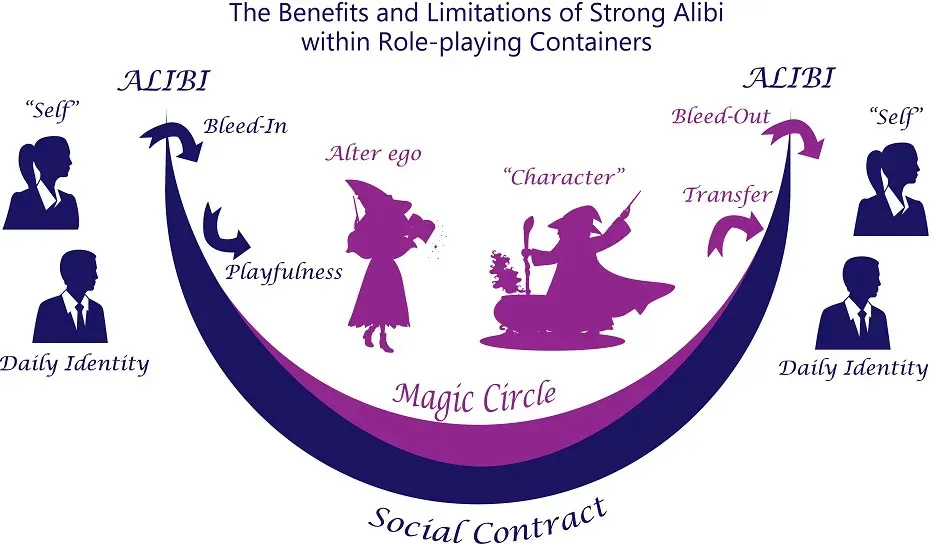
The Magic Circle, for those unfamiliar, is comparable to the “suspension of disbelief” in film. It is a space in which participants agree that the normal rules of reality be suspended, replaced by the rules of the game. Within the magic circle of a LARP event, for example, foam bats become mighty steel longswords, and red beanbags transform into magically conjured fireballs. In the words of ScribeOS creator Milo Duclayan: “The game is a lie. None of it works without buy-in from the players.” But how do we get this buy-in and persuade players to step into the magic circle? To tell the truth, that question somewhat answers itself—we persuade them. The magic circle should not be misconstrued as deception; it must be embraced consensually. ScribeOS lies to its players not by deceiving them but by wrapping them so thoroughly in the experience that they acquiesce to its lies willingly. I didn’t manage to figure out ScribeOS’s secret while playing, but if someone had run up and explained it, I’m quite confident I would have simply shrugged and resumed my nonsensical chanting. In Milo’s words, “Even if the player understands the computers aren’t connected, you can still elicit an emotional state. I wanted the player to cross the magic circle from the moment they hit the power button”.
ScribeOS maintains its magic circle through an ingenious method of simulating a networked environment: timing. ScribeOS always takes exactly 21 minutes to play to completion. Because playtime is a known factor, the game is able to trigger events for both players simultaneously, giving the impression that the two computers are connected, even if players know logically that they aren’t. Milo described to me how ScribeOS can be roughly broken into different “sections” with major events serving as the transitions between them. For example, the first 8 minutes of the game are “mood setting” before the first event fires. He also highlighted the key ingredient for getting these timings to work: “Through playtesting, I was able to estimate what players would feel and when.” The fruits of this testing are clear: ScribeOS always seems to know just how and when to push you in the right direction to keep things interesting. That it does this non-emergently with pre-defined twine stories is all the more impressive.
ScribeOS is a triumph of narrative design that redefines how stories can be told in games. It melds concepts from video games and live-action role-playing to produce something distinct from either. It’s a masterclass in the good ol’ smoke-and-mirrors that so much of game writing is built on. It also might make bystanders wonder if you’re having some kind of breakdown, but don’t let that stop you.
Special Thanks to Milo Duclayan for agreeing to be interviewed for this article. ScribeOS can be purchased Here